When Should a Solo Business Owner Convert to an S-Corp? The Math and the Timing
If you started your business as a solo contractor, real estate consultant, or independent healthcare provider, you probably set things up as a single-member LLC. It’s simple, flexible, and gets you up and running fast. But as your revenue climbs, most owners hit a point where they look at the tax bill and think, “there has to be a better way.” Often there is — and it’s called the S-Corporation tax election. Done at the right time, converting a solo business to an S-Corp can reduce self-employment taxes meaningfully every year. Done too early, the added administrative cost can quietly eat those savings alive.
Below is the framework an accounting and tax practice like Take Flight uses to help solo operators decide when an S-Corp election actually makes financial sense — and when it doesn’t yet.
The core problem: the 15.3% self-employment tax
As a standard LLC or sole proprietor, you pay ordinary income tax on your net business profit. On top of that sits the federal self-employment tax (SE tax) of 15.3%, which funds Social Security and Medicare. The catch is that this 15.3% generally applies to every dollar of net profit your business earns, up to the annual Social Security wage base (the 12.4% Social Security portion stops at that cap; the 2.9% Medicare portion keeps going).
If your business clears roughly $100,000 in net profit, that’s in the neighborhood of $15,000 in self-employment tax alone — before ordinary income tax touches a dollar of it. For many growing solo businesses, that is the single largest check they write each year.
The S-Corp solution: splitting your income into two buckets
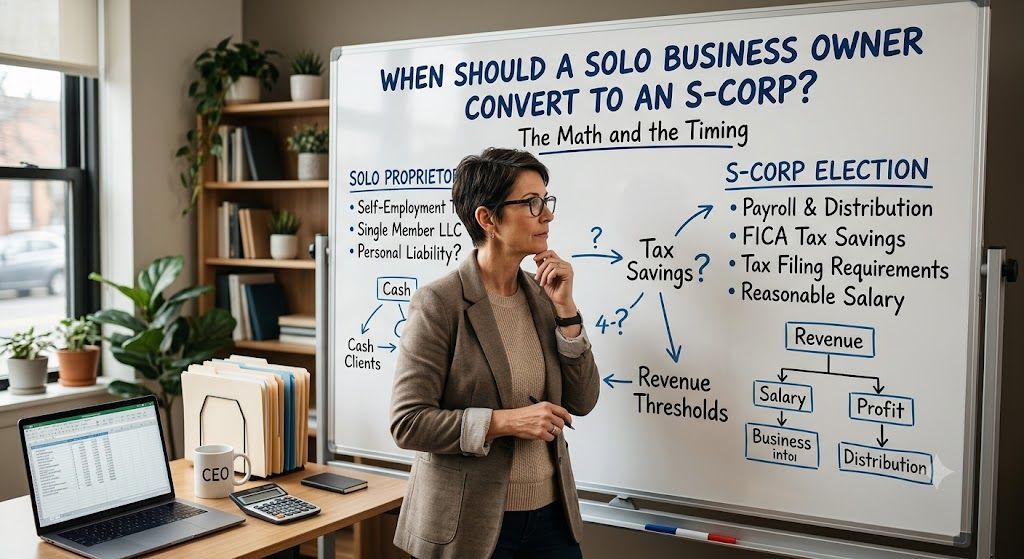
An S-Corp election changes the structure by letting you wear two hats: you are both the owner of the business and an employee of it. Instead of paying 15.3% SE tax on your entire profit, an S-Corp splits your income:
- W-2 salary (the employee hat). You pay yourself a “reasonable compensation” through a formal payroll system. Payroll taxes of 15.3% apply only to this salary.
- Shareholder distributions (the owner hat). Remaining profit flows to you as a distribution. Distributions are generally not subject to the 15.3% self-employment tax.
A simplified illustration. Say your solo business nets $120,000. As a standard LLC, roughly the full $120,000 is exposed to self-employment tax. If you elect S-Corp status and set a reasonable W-2 salary of $60,000, the 15.3% payroll tax generally applies only to that $60,000 — the remaining $60,000 passes through as a distribution outside the SE-tax base. That is on the order of $9,000 in reduced self-employment tax exposure in a single year.
This is a deliberately simplified example. Actual savings depend on your reasonable salary, the Social Security wage base, state rules, payroll-processing and tax-filing costs, and how the numbers interact with deductions such as the qualified business income deduction. Your real figure is only knowable once someone models it against your books.
When is the right time to convert? The profit tipping point
Because running an S-Corp adds administrative work — formal payroll, a separate corporate tax return (Form 1120-S), and tighter bookkeeping — you need enough tax savings to outweigh that overhead. There are two triggers worth looking for before making the leap:
- The profit tipping point. Your business should be consistently generating meaningful net profit — profit after expenses, not gross revenue. A common rule of thumb puts the conversation somewhere in the range of $60,000 to $80,000 or more in stable annual net profit. Below that, corporate payroll and compliance costs often wipe out the tax savings. Where your own line sits depends on your numbers.
- Stable, predictable cash flow. Because the IRS expects you to pay yourself a consistent, reasonable salary, your business needs cash flow steady enough to run regular payroll all year — not just in your strong months. Reliable cash-flow planning and budgeting is what makes that sustainable.
Common pitfalls of the solo S-Corp
Before you file IRS Form 2553, it’s worth understanding the compliance guardrails. The IRS tends to scrutinize solo S-Corps on two fronts in particular:
- “Reasonable compensation.” You can’t pay yourself a $10,000 salary and take $110,000 in distributions to sidestep payroll tax. Your salary should reflect what an independent professional in your industry and role would reasonably earn. Setting it too low is one of the most common triggers for IRS challenge.
- Bookkeeping discipline. Co-mingling personal and business funds is risky for any business, and for an S-Corp it can undermine the structure entirely. A clean, well-maintained general ledger — and a properly documented set of formations and compliance filings — is what keeps the election defensible.
Getting the election filed correctly is its own step. Our business formation and compliance filing support handles the paperwork, and ongoing tax reduction planning and preparation keeps the salary-versus-distribution split documented and current.
Does an S-Corp fit your industry?
The S-Corp question comes up most often for established solo operators in a few fields we work with closely, each with its own wrinkles:
- Contractors and trades with steady job volume, where profit after materials and subs is high enough to clear the tipping point.
- Real estate professionals and investors — though how rental income, agent commissions, and active-versus-passive treatment interact with an S-Corp deserves careful, case-by-case review.
- Independent healthcare and medical providers billing through their own practice, where reasonable-compensation standards for licensed professionals are especially important.
- Hospitality and restaurant owners operating a profitable single-owner location.
Not sure whether the math works for your situation? A short business consulting conversation can model it before you commit to anything.
How Take Flight approaches the S-Corp decision
Take Flight Business Solutions is an accounting and tax practice with CPAs on staff, based in Pensacola and Cantonment and serving clients across Northwest Florida — including Gulf Breeze and Pace — and nationwide through secure cloud platforms. Rather than guessing at the timing, we model your specific numbers: current SE-tax exposure, a defensible reasonable salary, the all-in cost of payroll and the corporate return, and the projected net benefit. If the math doesn’t clear the bar yet, we’ll tell you that too — and revisit it as your profit grows. Any election, payroll setup, and pricing are confirmed in a written engagement, and the practice does not perform audit or attest services.
Ready to look at the math for your business?
Book a no-obligation strategy meeting and we’ll model whether a solo S-Corp election makes financial sense for you — and, if so, when to make the move.
Prefer to talk now? Call 850-303-2133 or contact our team.
Frequently asked questions
At what income should a solo business owner consider an S-Corp?
There’s no single legal threshold, but the tax savings only outweigh the added payroll and compliance costs once your business is generating stable net profit — often discussed in the range of roughly $60,000 to $80,000 or more per year after expenses. The right line for your business depends on your actual numbers and cash flow, which is why it’s worth modeling before you file.
How does an S-Corp reduce self-employment taxes?
An S-Corp lets you split your income into a W-2 salary and shareholder distributions. Payroll taxes of 15.3% generally apply only to the salary, while distributions are typically outside the self-employment tax base. Because you pay the 15.3% on a smaller portion of your profit, your total employment-tax exposure can fall — provided your salary meets the IRS reasonable-compensation standard.
What is “reasonable compensation” for an S-Corp owner?
Reasonable compensation is the salary a comparable professional would earn for the work you actually perform in the business, considering your role, industry, experience, and hours. The IRS scrutinizes salaries that appear artificially low relative to distributions. There’s no fixed formula, so it should be documented and supportable based on your specific facts.
What extra work does running an S-Corp require?
An S-Corp generally requires running formal payroll for your salary, filing a separate corporate tax return (Form 1120-S), keeping business and personal finances strictly separate, and maintaining clean, current books. These add cost and administrative effort, which is exactly why the tax savings need to be large enough to justify the switch.
Can I switch my existing LLC to an S-Corp?
In many cases, yes — an LLC can elect to be taxed as an S-Corporation by filing IRS Form 2553, subject to timing rules and eligibility requirements. The LLC itself usually stays intact; what changes is how it’s taxed. Because the filing deadlines and eligibility details matter, it’s best to confirm the specifics for your situation before filing.
Sources
- Internal Revenue Service — Topic No. 751, Social Security and Medicare Withholding Rates
- Internal Revenue Service — Self-Employment Tax (Social Security and Medicare Taxes)
- Internal Revenue Service — S Corporations (including Form 2553 election)
- Internal Revenue Service — S Corporation Employees, Shareholders and Corporate Officers (reasonable compensation)
This article is provided by Take Flight Business Solutions LLC for general informational and educational purposes only. It does not constitute tax, legal, accounting, or financial advice, does not create a client or professional relationship, and should not be relied upon as a substitute for advice from a qualified professional who has reviewed your specific circumstances. Take Flight Business Solutions LLC is an accounting and tax practice with CPAs on staff; it does not perform audit or attest services. All tax figures, dollar amounts, savings estimates, and income thresholds in this article are simplified illustrations only — they are not guarantees, offers, or projections of results, and your actual outcome will differ based on your facts, your reasonable compensation, applicable wage-base limits, state and local rules, and additional costs such as payroll and tax preparation. S-Corporation status is not right for every business and can increase costs and compliance obligations. Tax laws and IRS positions change and apply differently to each taxpayer; consult a qualified tax professional and confirm current requirements before making any election or acting on any information here. Any services referenced are governed solely by a signed engagement agreement.