Florida’s $15 Minimum Wage: What Happens After September 30, 2026

On September 30, 2026, Florida’s minimum wage reaches $15.00 per hour — the final step in the six-year schedule voters approved in November 2020. Most of the coverage stops there. But for owners running payroll in Pensacola, Cantonment, and across Northwest Florida, the more useful questions start after that date: when does the next increase actually hit, and how is it calculated? The answers are not what most published summaries suggest, and getting them wrong can put your payroll budget off by a meaningful margin.
Two details in particular tend to get reported incorrectly. First, there is no increase on September 30, 2027 — the rate holds at $15.00 for fifteen months. Second, Florida does not index to the national inflation number you see in the headlines. Here is how the mechanism actually works, where to find the right figure, and the cost most owners underestimate.
What changes on September 30, 2026
Florida’s minimum wage was raised by constitutional amendment approved by voters in November 2020, which set a schedule beginning at $10.00 on September 30, 2021 and rising $1.00 each September 30 until reaching $15.00 on September 30, 2026.
For tipped employees, Florida permits a tip credit capped at the amount allowable under the federal Fair Labor Standards Act as of 2003 — $3.02. That produces a required direct cash wage of $11.98 per hour at the $15.00 rate. Because the credit is fixed at that 2003 figure rather than indexed, it does not grow as the minimum wage rises. Every future increase in the state minimum wage passes through to tipped cash wages dollar for dollar, which matters more for restaurants and hospitality operators than for most other employers.
Employers are also required to post the updated minimum wage notice at each work location. Current posters are available from the Florida Department of Commerce.
The fifteen-month pause most summaries miss
This is the part worth marking on a calendar. Under Article X, Section 24 of the Florida Constitution, the first inflation-indexed calculation does not occur until September 30, 2027 — and the constitutional text provides that each adjusted rate calculated is published and takes effect on the following January 1.
Put together, that means:
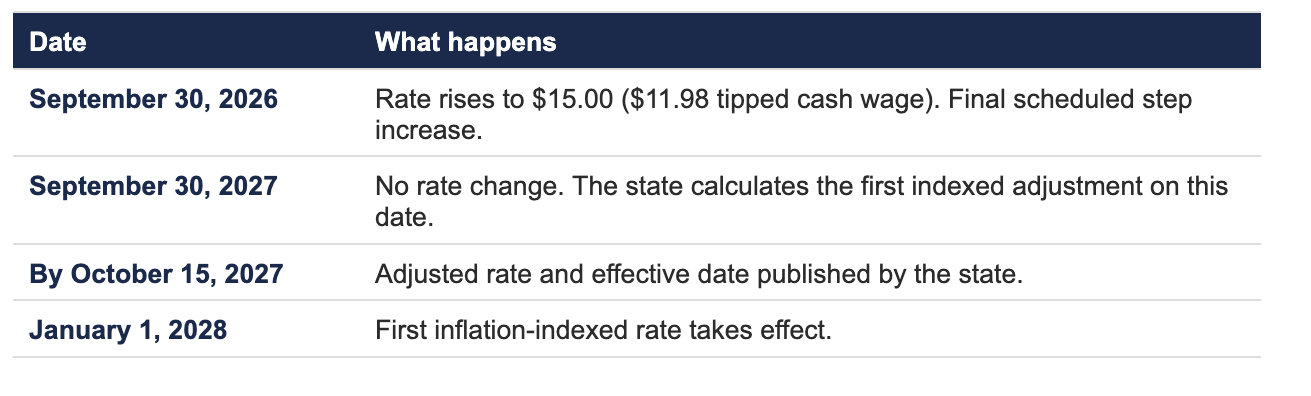
So the $15.00 rate holds from September 30, 2026 through December 31, 2027. If you have seen guidance suggesting the next increase lands on September 30, 2027, that reflects the pattern of the 2021–2026 step increases, which are now finished. The indexing provision uses a different effective date.
That fifteen-month window is the single most useful thing in this article. It is a planning runway — the last stretch of predictable labor cost before the rate starts moving on its own.
The index Florida actually uses — and why the national number will mislead you
The index Florida actually uses — and why the national number will mislead you
Here is where a lot of published guidance goes wrong, including guidance written by people who should know better.
The constitutional text refers to the Consumer Price Index for Urban Wage Earners and Clerical Workers (CPI-W) as calculated by the U.S. Department of Labor. The implementing statute, Florida Statutes § 448.110(4)(a), is more specific: it directs the Department of Commerce to use the CPI-W, not seasonally adjusted, for the South Region. That is also the series the state has cited in its own published rate announcements going back years.
This is not a technicality. The South Region series and the national U.S. City Average series can diverge by more than a percentage point, and in recent periods they have. Budgeting off the national CPI-W figure you see in the monthly headlines can materially overstate or understate what Florida actually adopts.
An arithmetic illustration, not a forecast. If the applicable 12-month CPI-W change came in at 2.0%, applying that to $15.00 produces $15.30. At 3.0%, it produces $15.45. The difference across a 25-person hourly roster working full time is roughly $7,800 a year — before payroll taxes and before any adjustment to the wages above the floor.
These figures are simple arithmetic on hypothetical inputs. They are not projections, and no one knows the 2027 rate today. The published state rate governs.
Where to find the right number
You do not have to wait to be told. Both figures are public.
The federal data (Bureau of Labor Statistics)
The measurement window is the 12 months prior to September 1, so the August CPI-W release — typically published in mid-September — is the first look at what the adjustment is likely to be.
One important trap: the BLS monthly South region news release headlines CPI-U, not CPI-W. They are different series with different weightings. Pulling the number off the top of that release gets you the wrong index even though you are on the right regional page.
To get the correct series, use the BLS CPI-W database query tool and select the South region, All items, not seasonally adjusted. General CPI information is at bls.gov/cpi.
The state figure (Florida Department of Commerce)
Under § 448.110(4)(b), the Department of Commerce and the Department of Revenue must post the adjusted rate and its effective date on their websites by October 15 each year. The Department of Commerce is also directed to mail written notice of the adjusted rate to employers registered in the state reemployment assistance database by November 15, to the extent funded — which means the address on file for your business should be current.
The official state page is
floridajobs.org/florida-minimum-wage, which carries the current rate and the required posters.
The cost that isn’t in the headline: wage compression
For labor-heavy operations — restaurants, medical and senior care practices, and multi-crew contractors — the real budget impact is rarely the headline increase itself.
When the floor moves to $15.00, the gap between an entry-level employee and an experienced shift lead earning $16.50 narrows sharply. The lead did not get a raise, but the distance that justified their pay just compressed. In practice this tends to show up as retention pressure, requests for adjustment, and turnover in exactly the roles that are hardest to replace.
The size of that second-order cost depends entirely on how your roster is distributed above the floor, which is why it is worth modeling against your actual payroll rather than assuming a rule of thumb. Two businesses with identical entry-level headcount can face very different compression exposure.
Using the fifteen months
A predictable window is a good time to do the work that is hard to do under deadline. Depending on your situation, that might include:
- Mapping your wage bands. Pull every hourly rate and see how many employees sit within a few dollars of $15.00. That distribution is your compression exposure, and it is specific to you.
- Tracking prime cost, not just labor. For food service in particular, labor and cost of goods move together. Watching them as a combined percentage of revenue tends to be more informative than either in isolation, and clean monthly bookkeeping is what makes that number trustworthy.
- Revisiting pricing on a schedule. Many owners delay price adjustments until margin pressure forces the issue. Smaller, planned adjustments are generally easier to communicate than a single large one.
- Building a rolling cash-flow view. A static annual budget does not show you how a January rate change interacts with a seasonal revenue trough. Rolling forecasts and budgeting tend to surface that earlier.
- Confirming payroll setup and classifications. Rate changes are a reasonable prompt to verify that payroll records, tip credit handling, and worker classifications are accurate before an increase compounds any existing error.
None of this is urgent in the way a filing deadline is urgent. That is precisely why it usually does not get done.
How Take Flight approaches it
Take Flight Business Solutions is an accounting and tax practice with CPAs on staff, based in Pensacola and Cantonment and serving clients across Northwest Florida — including Gulf Breeze and Pace — and nationwide through secure cloud platforms.
For owners facing a wage change, the work is usually straightforward: get the books current enough that labor cost is actually visible, model the compression exposure against the real roster, and build a cash-flow view that extends past the next rate change. Business consulting and tax planning and preparation support can be scoped alongside that where it fits. Any services and pricing are confirmed in a written engagement, and the practice does not perform audit or attest engagements.
Want to see what $15.00 does to your payroll?
Book a no-obligation strategy session and we’ll walk through your wage bands, your labor-cost trend, and what the fifteen-month window gives you room to plan for.
• Or call 850-303-2133
Frequently asked questions
What is Florida’s minimum wage on September 30, 2026?
Florida’s minimum wage rises to $15.00 per hour on September 30, 2026, the final step in the schedule approved by voters in November 2020. For tipped employees, the allowable tip credit is $3.02, producing a required direct cash wage of $11.98 per hour.
Does Florida’s minimum wage increase again on September 30, 2027?
No. The scheduled step increases end at $15.00. Under Article X, Section 24 of the Florida Constitution, the first inflation-indexed adjustment is calculated on September 30, 2027 and takes effect the following January 1 — January 1, 2028. The rate holds at $15.00 in the interim.
Which inflation index does Florida use for its minimum wage?
Florida Statutes § 448.110(4)(a) directs the Department of Commerce to use the Consumer Price Index for Urban Wage Earners and Clerical Workers (CPI-W), not seasonally adjusted, for the South Region. The measurement period is the 12 months prior to September 1. The national U.S. City Average CPI-W figure reported in most monthly headlines is a different series and can produce a materially different result.
When will the 2028 Florida minimum wage rate be announced?
Under § 448.110(4)(b), the Department of Commerce and the Department of Revenue must publish the adjusted rate and effective date on their websites by October 15. Written notice to employers registered in the state reemployment assistance database is directed to be mailed by November 15, to the extent funded.
What is wage compression and why does it matter here?
Wage compression is the narrowing of pay differences between newer and more experienced employees when the wage floor rises. Raising entry-level pay to $15.00 shrinks the gap to employees already earning slightly above it, which can create retention pressure in supervisory and skilled roles. The cost depends on how a specific roster is distributed above the floor.
Can a Florida city or county set a higher minimum wage?
Local wage ordinances have been constrained by Florida’s preemption framework, and no Florida locality currently enforces a general minimum wage above the state rate. Employers with multi-state operations should confirm requirements for each jurisdiction where employees perform work.
Sources
- Florida Constitution — Article X, Section 24 (Florida minimum wage)
- The Florida Senate — Florida Statutes § 448.110: https://www.flsenate.gov/laws/statutes/2025/448.110
- Florida Department of Commerce — Florida Minimum Wage: https://floridajobs.org/florida-minimum-wage
- U.S. Bureau of Labor Statistics — Consumer Price Index: https://www.bls.gov/cpi/
- U.S. Bureau of Labor Statistics — CPI, South Region: https://www.bls.gov/regions/southeast/news-release/consumerpriceindex_south.htm
- U.S. Bureau of Labor Statistics — CPI-W database query tool: https://www.bls.gov/help/one_screen/cw.htm
This article is provided by Take Flight Business Solutions LLC for general informational and educational purposes only. It does not constitute tax, legal, accounting, payroll, employment, or financial advice, does not create a client or professional relationship, and should not be relied upon as a substitute for advice from a qualified professional who has reviewed your specific circumstances. Take Flight Business Solutions LLC is an accounting and tax practice with CPAs on staff; it does not perform audit or attest services and does not provide legal representation. Wage-and-hour compliance is a legal matter governed by federal, state, and local law; employers should consult qualified employment counsel regarding their obligations. All dollar amounts, rates, percentages, and cost illustrations in this article are simplified examples only — they are not guarantees, offers, quotes, or projections of results, and future minimum wage rates are not knowable in advance. Statutory and constitutional provisions are summarized, not reproduced, and are subject to amendment, administrative interpretation, and judicial construction; the official published rate and the current text of the law govern. Verify all figures against the Florida Department of Commerce and the U.S. Bureau of Labor Statistics before acting. Any services referenced are governed solely by a signed engagement agreement.